
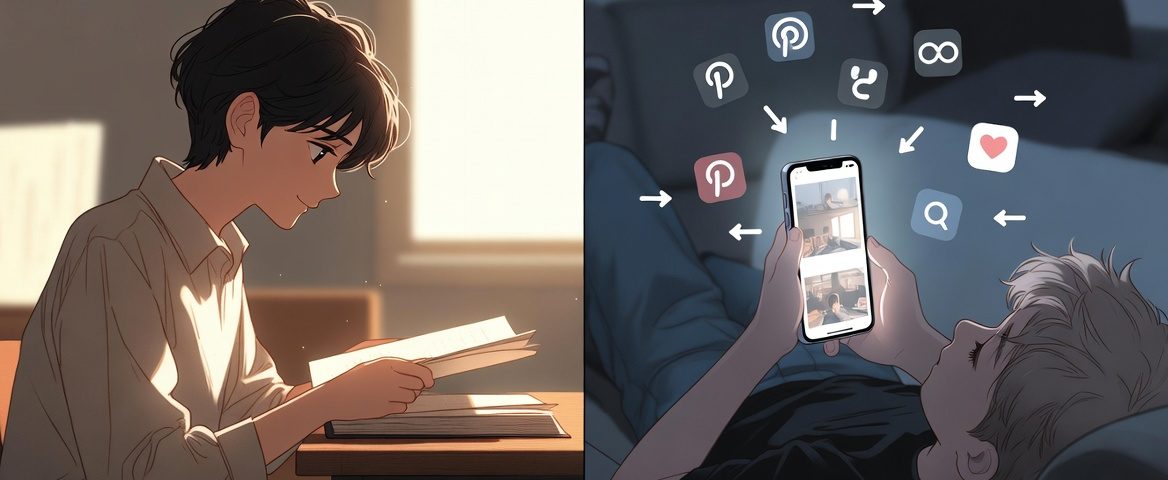
There is a change that can be clearly observed in everyday life, and it goes beyond a simple preference in entertainment. A growing part of the population, especially among the young, gets informed and entertained almost exclusively through short videos: TikTok, Instagram Reels and YouTube Shorts. The format is always the same: stimuli lasting a few seconds, endless scrolling and immediate reward. Facing them are those who maintain the habit of reading longer texts — books, articles or web pages with some development. The difference is not only one of taste. It is a difference in the way of paying attention, of processing information and, ultimately, of understanding the world.
Prolonged reading forces the brain to work in a specific way. You have to follow an idea, keep it in memory, relate it to what comes next and tolerate a slower pace. That effort sustains attention and allows a more or less solid reasoning to be built. Intensive consumption of short videos works the opposite way. Every few seconds the stimulus changes: the image, the music, the cut, the text on the screen. The brain gets used to receiving quick rewards and not staying too long on a single piece of content. When it later faces a dense text, that same brain tires sooner. It finds it heavy. It gives up more easily. This is not a matter of willpower. It is a matter of training.
This shows up very clearly in practice. Many people are no longer able to read a web page from beginning to end. They open an article, read the first few lines and move on to something else. They prefer a video that summarises the idea in a minute or less. The information reaches them already chewed, with emotional charge and without the need for effort. Those who read, on the other hand, tend to search, compare and go back if necessary. They can stop at a paragraph, reread it and relate it to something they already knew. They build a more complete idea, even if it takes them more time. That difference in method ends up generating differences in depth.
The consequences are visible in several areas. Those who get informed mainly through short videos know the headline and the feeling, but frequently miss the development or the nuances. They find it harder to detect when something is incomplete, biased or outright false. They also find it more difficult to sustain a conversation on complex topics that cannot be resolved in twenty seconds. Misinformation enters more easily because it arrives packaged, with music and with an appearance of truth. The ability to doubt, to go to the source and to cross-check weakens when it is hardly exercised. It is not that people become less intelligent. It is that they practise less the skills that allow thinking with a bit of distance.
This phenomenon does not affect only information. It has consequences in study, at work and in daily life. In secondary schools and universities it is frequently observed that many students have difficulties concentrating on long texts or on explanations that do not come accompanied by constant stimuli. Something similar happens in the workplace: it becomes harder to maintain attention on reports, documents or conversations that require following a thread for a while. And in everyday conversations impatience is noticeable: the quick phrase, the summary, the impact is expected. Whatever does not arrive immediately loses interest.
This is not about declaring that the short video is bad or that the book is superior by definition. Each format has its usefulness. Video can explain visual ideas clearly, reach many people and make accessible what previously seemed distant. The problem appears when one of the two formats occupies almost all available attention time. Then the brain adapts to what it practises most. If for hours it receives rapid and fragmented stimuli, sustained attention becomes more costly. And when it is necessary to read properly, concentrate or think calmly, the effort turns out greater than it should be.
There are important nuances. Not everyone who uses these platforms is trapped in endless scrolling. There are people who combine both worlds: they watch videos and also read. There are those who use the short format deliberately and do not lose the ability to concentrate. The problem is not occasional use, but dominant and prolonged use. When scrolling becomes the main means of information and entertainment, the consequences accumulate.
That is the change that is taking place. It is not a question of intelligence or of morals. It is a question of habit and of training. And it shows in how people find out about things, in how they hold an idea and in how they respond when they are asked for something more than a headline. The difference between those who read and those who only scroll is not small. It is a difference in the way of paying attention to the world. And that, in the long run, matters.